
by Max Hannus
Do you see me?
We all share the need to be seen, to be taken into account, to be included. Psychotherapist Esther Perel describes intimacy as ‘into me see’: seeing someone deeply and being seen by them in return. The exhibition Moon in Your Mouth looks at processes of desire and intimacy in relation to questions of access. If we think of intimacy as seeing and being seen, what is required for the seeing to take place?
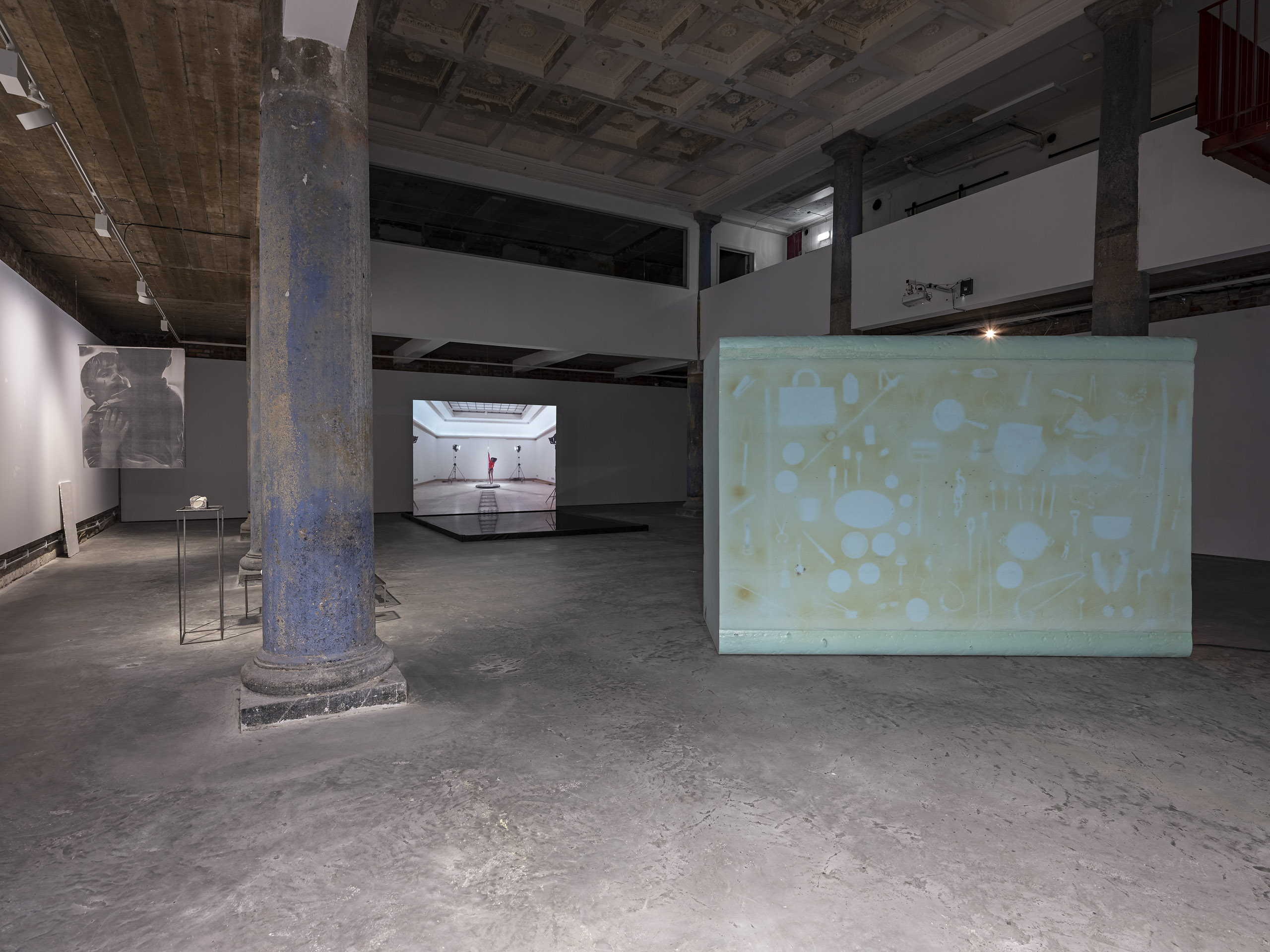
Tarek Lakhrissi’s film Spiraling (2021) explores voyeurism, the desire to watch, reformulating it as consensual, respectful of the object, the performing body. Lakhrissi films his friend, professional pole dancer and queer activist Mila Furie. At the end of the film, the performer looks back at the viewer, confronting our gaze. With this action, Furie’s performing body transforms space and changes an uncomfortable situation, assuming control and soothing herself.
Control, and how it is wielded over certain bodies, is also the subject of Inari Sandell’s A Matter of Constructing a Person (2023). This series takes as its starting point an article published in the 1960s describing an approach to the behavioural treatment of children on the autistic spectrum, in which the child would be rewarded with a treat for giving a ‘proper’ hug, but given an electric shock for the ‘wrong kind’ of interaction. These kinds of ideas and their legacy weigh heavily still, bypassing as they do questions of consent and bodily autonomy, and gatekeeping who has access to comfort and intimacy on their own terms.
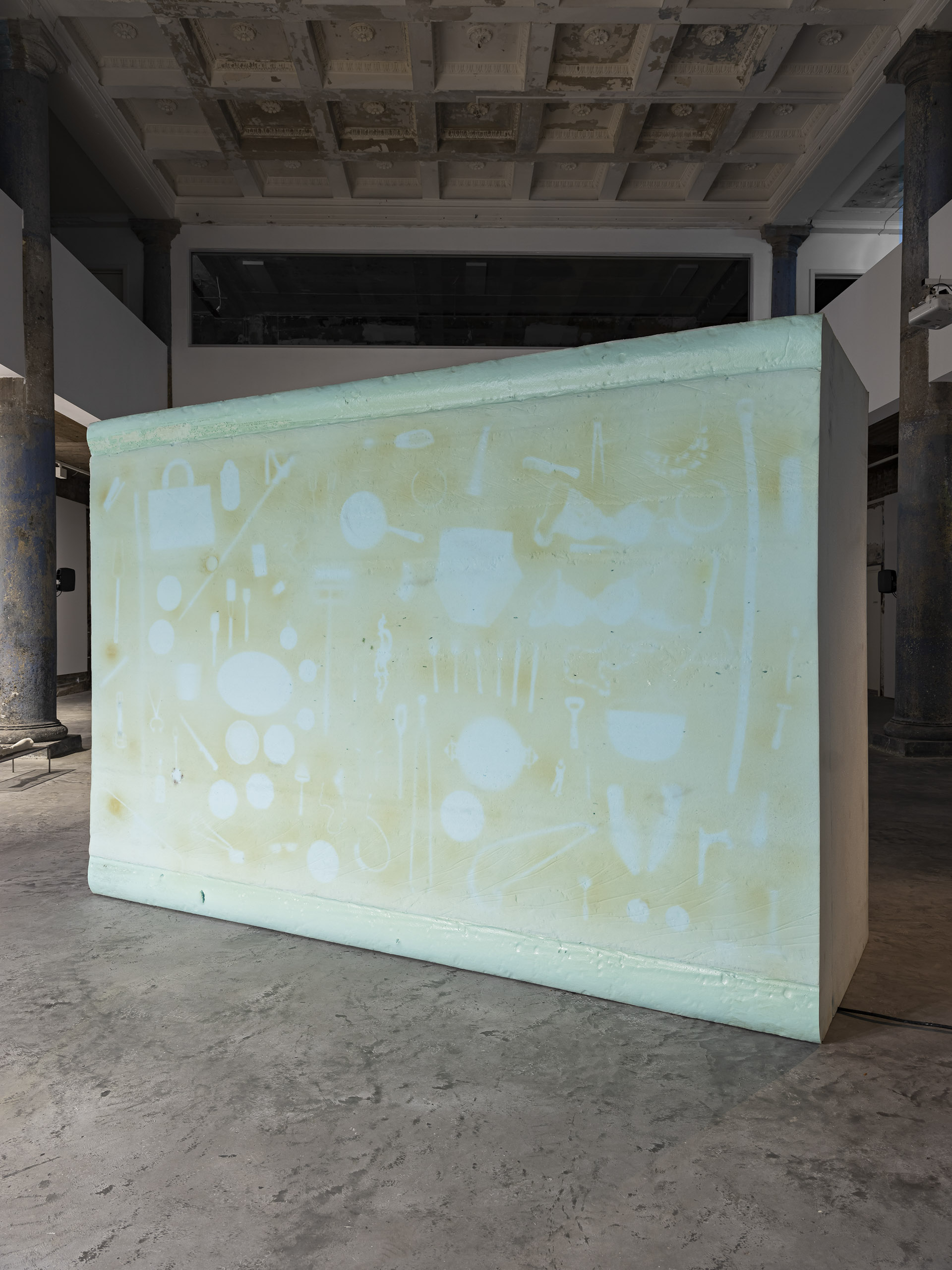
In Thora Dolven Balke’s installation When a Meteorite Hits the Kitchen Table (2023), sound emanates from a massive block of blue mattress foam. Voices recount situations in the home when a sudden shift in reality happens – like the sighting of a meteor impact, a fire or an episode of extreme weather. The artist combines news broadcast eyewitness accounts with a fleeting inventory of her late grandmother’s personal belongings, listed and silhouetted onto the work with UV light, showing how exposure can be an act of care and remembrance, while also breaching the boundaries of intimate space.
Being open to the other, to allowing others in, is a vulnerable position. One risks becoming subject to violence, disappointment, loneliness and loss. Moon in Your Mouth revolves arounds these important negotiations and relationships. Why is it so hard to see each other?
Meandering thoughts on intimacy and access
Earlier this spring I met with a friend. We talked about practices of consent and intimacy, and how we consider them in our respective lines of work. I told her I was wondering whether we can learn about consent in the process of putting artworks on display, placing them as objects.My main question was: when we think about desire and intimacy, how can we work to make this intimacy accessible; how do we give and receive this access? In The UltimateGuide to Kink: BDSM, Role Play, and the Erotic Edge (2012),author, filmmaker and sex educator Tristan Taormino describes consent as ‘an explicit, informed verbal approval after negotiation, a confident and secure Yes!’.
The term ‘consent’ is widely used in sexual contexts, where it refers to the permission to perform certain agreed-upon sexual acts. And it is tied to temporality: it is not enough to get consent once and expect it to hold. You must get a ‘yes’ over and over again. Sometimes this might lead to nothing happening, partly because, as author and researcherMaggie Nelson puts it in On Freedom: Four Songs of Care and Constraint (2021), ‘saying no is hard, but so is saying yes, especially if it involves something more or different than acquiescence’.
I confessed to my friend that in my work I was suffering from ‘consent fatigue’. I was simply tired; tired of ruminating and talking. I longed for ease and comfort, the feeling of things just running smoothly. It started making more and more sense forme to focus on protecting my own and others’ resources. That meant communicating less frequently, but more clearly. (Usually we curators tend to flood the terrain with words and exhaust everyone with negotiations.) I also needed simplification. This realisation relates to what author, pedagogue and organiser Mia Mingus calls ‘access intimacy’. In her 2011 article ‘Access Intimacy: The Missing Link’ she writes:
access intimacy is that elusive, hard to describe feeling when someone else ‘gets’ your access needs. The kind of eerie comfort that your disabled self feels with someone on a purely access level. Sometimes it can happen with complete strangers, disabled or not, or sometimes it can be built over years. It could also be the way your body relaxes and opens up with someone when all your access needs are being met.
I believe that taking steps towards more inclusive and accessible practices is key in building sustainable (work)relationships, even if accessibility isn’t the same for everyone.And spending time with artworks and practices that actively reach out for love and connection makes me feel more loving and more connected, making space for intimacy. I hope it does for you too.
Love, Max Hannus